
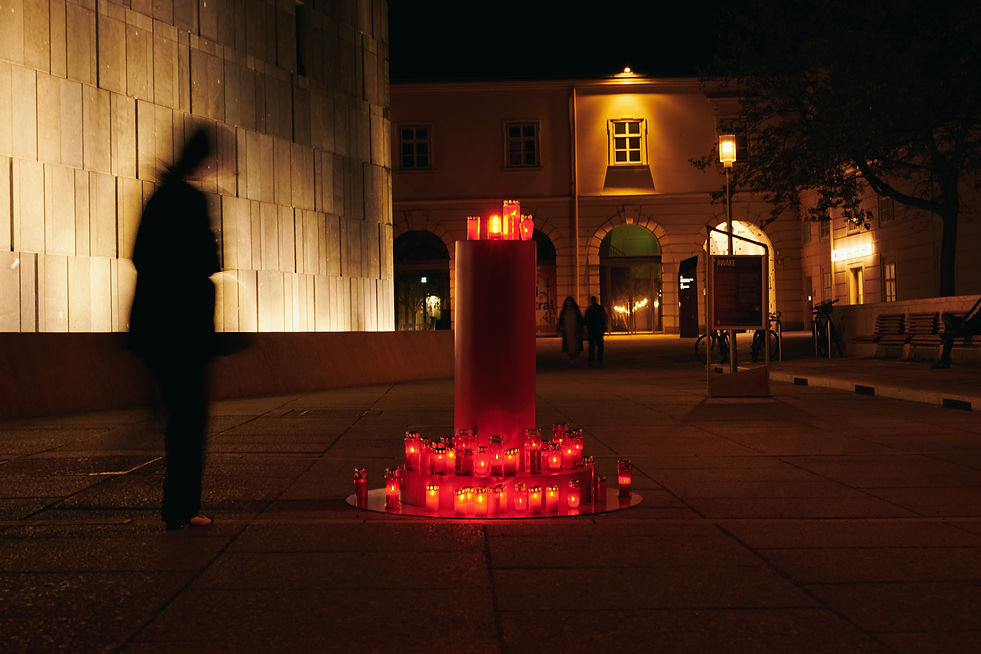
Šejla Kamerić, "AWAKE", 2026. Site-responsive light installation. Photo: Vedran Husremovic.
Worlds in Repair, December 11 - 22, Berlin
We are delighted to announce the upcoming programme series Worlds in Repair. Taking place from 11 to 22 December 2026, the series will unfold across various locations in Berlin, including Studio 1, Kunstquartier Bethanien, Kindl – Centre for Contemporary Art, and public space.
In an era defined by endless wars, militarization, borderless armed violence, and the capitalist destruction of ecological habitats, the question of how repair can be imagined and reparation practiced has become unavoidable.
Worlds in Repair brings together artists, curators, and scholars through an exhibition, symposia and engagement with artworks to explore how art and critical learning can serve as acts of repair. As a collective effort, it turns to haunting memories and confronts the transgenerational and enduring impacts of historical violence, displacement, and the destruction of cultural heritage while opening up to unknowable futures. It centres repair as inseparable from justice, calling for responsibility toward what has come to pass or the endurance of colonial histories or memories, and toward the ethical, ecological, and political challenges of the 21st century. At the same time, it resists fixed interpretation and the violence of hierarchical knowledge that pervades political and cultural institutions, opening space for new ways of imagining our world beyond the politicised divisions of heritage, social, and cultural that are becoming inescapable in our historical moment.
The works presented in the exhibition, the contributions to the symposium, and the programme in public space reflect on the central themes of repair, reparation, and justice. Particular attention is given to confronting colonial violence, its narratives, remembrance, and commemoration, its enduring consequences in the present, and the necessity of collective acts of resistance.
The programme is conceived as un-disciplinary, foregrounding the equal exchange of knowledge and experiences beyond disciplinary frameworks.
Participants
Ayman Alazraq, Kerylos Aziz, Ariella Aïsha Azoulay, Memory Biwa, Debasish Borah, Marc Da Costa, Nikita Dhawan, Forensic Architecture and Forensis, Šejla Kamerić, Madeleine Kneissig, Ewa Majewska, Abdessamad El Montassir, Yara Mekawei, Ciraj Rassool, Elena Sinanina, Sonya Schönberger, Kamala Vasuki (Vasuki Jeyasankar).
As well as contributors from the Städtische Galerie im Lenbachhaus und Kunstbau München: Mona Feyrer, Lisa Kern; and the Provenance Lab, Leuphana University Lüneburg: Lynn Rother, Claudia Andratschke, Agustina Andreoletti, Nnenna Onuoha.
Curation Elena Sinanina with Sandeep Sodhi, Dr. Fazil Moradi and team Curation Outside Eye Madeleine Kneissig Project Management Jasna Witkoski, Carina Panther Technical Direction Christopher von Nathusius Graphic Design Bardhi Haliti Press Relations Rafael Sergi Production Management Elisa Maria Schmitt Photography Lutz Knospe
Worlds in Repair is an un-disciplinary program series funded by the Capital Cultural Fund (HKF) and by the Friedrichshain-Kreuzberg District Office as part of the Integration Fund, a district-level neighbourhood program, using funds from the Senate Department for Labor, Social Affairs, Gender Equality, Integration, Diversity, and Anti-Discrimination. Supported by Goethe-Institute. In cooperation with Kunstraum Kreuzberg/ Bethanien and Kindl – Centre for Contemporary Art. Institutional partners: Städtische Galerie im Lenbachhaus und Kunstbau München and Provenance Lab at Leuphana University Lüneburg.
Produced by Initiative BLACK LAND e. V., a Berlin-based non-profit organization dedicated to promoting art and culture, chaired by Elena Sinanina and Yara Mekawei.
The programme will be held in English.
OPENING PROGRAMME
11 December 2026
13:30 Debasish Borah, Is this the Museum of European Civilisation? — Lecture Performance
Location: Sanchi Gate, in front of the Humboldt Forum, Schloßplatz, 10178 Berlin
16:30–20:00 Šejla Kamerić, AWAKE — Performative Installation
Location: Mariannenplatz, in front of Kunstquartier Bethanien
18:00 Exhibition Opening
Location: Studio 1, Kunstquartier Bethanien, Mariannenplatz 2, 10997 Berlin
19:00–20:00 Performance by Yara Mekawei and Kerylos Aziz
Location: Studio 1, Kunstquartier Bethanien, Mariannenplatz 2, 10997 Berlin
12 December 2026
11:00–12:00 Guided Tour with Kerylos Aziz, Egyptology, Archaeological Sites in Egypt and Traces of Hatshepsut in Berlin
Location: In front of Dussmann das KulturKaufhaus, Friedrichstraße 90, 10117 Berlin; Museum Island; and in front of the Neues Museum, Bodestraße 1–3, 10178 Berlin
Symposium
Location: Kindl – Centre for Contemporary Art, Am Sudhaus 3, 12053 Berlin
Admission from 14:00, programme begins at 14:30 with an introduction.
15:00–17:00 | Panel Discussion
Enlightenment, Colonial Plunder, the Return of Hatshepsut
Prof. Dr. Nikita Dhawan, Kerylos Aziz, Elena Sinanina, Yara Mekawei
17:15–18:00 | Presentation and Conversation
Städtische Galerie im Lenbachhaus and Kunstbau München
Mona Feyrer and Lisa Kern
13 December 2026
Symposium
Location: Kindl – Centre for Contemporary Art, Am Sudhaus 3, 12053 Berlin
Admission from 9:30, programme begins at 10:00.
10:00–12:00 | Panel Discussion
Mythologies, Biographies, the Ghosts of Colonialism
Sonya Schönberger, Kamala Vasuki, Šejla Kamerić, Prof. Dr. Ewa Majewska
12:15–14:15 | Panel Discussion
Colonialism, Architecture, Archive
Ayman Alazraq, Prof. Dr. Ciraj Rassool, Dr. Memory Biwa, Dr. Debasish Borah
15:00–17:00 | Presentation and Conversation
Provenance Lab, Leuphana University Lüneburg
Agustina Andreoletti, Nnenna Onuoha, Prof. Dr. Lynn Rother, Dr. Claudia Andratschke
17:15–18:00 | Film Screening
Ariella Aïsha Azoulay, Palestine is there, where it had always been (2026)
18:00–19:45 | Discussion and Closing Session
Exhibition
11–21 December, Studio 1, Kunstquartier Bethanien
The exhibition brings together a selection of new and existing works by international artists and collectives, engaging in a dialogue across different practices and perspectives.
Sound artist Yara Mekawei presents a new composition and installation, developed in collaboration with Egyptologist Kerylos Aziz, exploring the histories and legacies of the ancient Egyptian pharaoh Hatshepsut.
Marc Da Costa presents a new video work examining the visual representation of Western imperial archaeological excavations in digital contexts. The work questions the evidentiary value of images circulating in the public domain, their significance for museums and academic research, and the implications of the growing influence of artificial intelligence.
In her new installation, Sunset Blue, 2026, artist and historian Memory Biwa addresses the genocide of German colonial rule in Namibia through dissonant fragments of the Blue Book, and related oral histories and embodied archive to invoke the continous cycle of resilience and claims for reparative justice.
In The Lost Tapes of a People’s Tribunal, 1982, Ayman AlAzraq presents newly found video recordings from a people’s tribunal in Oslo after the Sabra and Shatila massacres, alongside photographs, slides, and documents. Through a spatial installation, he explores how neglected archives and personal testimonies keep memories of political violence alive and carry demands for justice across generations.
Drawing on oral testimony, archival records, and digital landscape reconstructions, the research agencies Forensic Architecture and Forensis, working in partnership with the Nama Traditional Leaders Association and the Ovaherero Traditional Authority, investigate the cumulative and enduring legacies of German colonialism and the genocide of the Ovaherero and Nama, tracing environmental degradation and land dispossession and supporting demands for environmental reparations and land restitution.
With her site-specific light installation AWAKE, which will be presented in Berlin for the first time on 11 December to mark the opening of the Worlds in Repair programme, artist Šejla Kamerić creates a space for collective remembrance and quiet solidarity, calling for vigilance, empathy, and collective responsibility.
In his film Galb’Echaouf, Abdessamad El Montassir presents the landscape of Western Sahara as a repository of suppressed memories, where stones, plants, and oral histories bear witness to violence, displacement, and resistance beyond official historical narratives.
The Berlin-based artist Sonya Schönberger examines, in collaboration with Christof Zwiener, how material remnants of the Second World War in Berlin preserve individual memories, life stories, and traces of destruction. In her installation Scherben (Shards), she works with fragments of glass, ceramics, and porcelain from everyday objects recovered from Berlin’s rubble mounds.
In War Damage Maps, Sonya Schönberger engages with war(s), documentation, and collective memory through cartographic records of the destruction of various German cities as collateral damage of the Second World War.
Artist, feminist, and human rights activist Kamala Vasuki (Vasuki Jeyasankar) creates an installation commemorating those who were forcibly disappeared as a result of war and violence in Sri Lanka and whose whereabouts remain unknown to this day. The work also invites visitors in Berlin to engage with these memories and histories that have been suppressed or silenced.
INFORMATION AND OPENING HOURS
Installation AWAKE: 11 December, 16:30-20:00
Exhibition
11 December 2026: 18:00–20:00
12–21 December 2026: 10:00–18:00
Curatorial Tours: 15–21 December 2026, daily, 13:00–14:00, no registration required, admission free.
Symposium
12 December 2026: 14:30–18:00
13 December 2026: 10:00–19:45
Tickets for the symposium, the guided tour with Kerylos Aziz, and the lecture by Debasish Borah will be available from 1 November 2026 via our website.
Addresses
Studio 1, Kunstquartier Bethanien
Mariannenplatz 2, 10997 Berlin
Kindl – Centre for Contemporary Art (Maschinenhaus)
Am Sudhaus 3, 12053 Berlin
Sanchi Gate, in front of the Humboldt Forum
Schloßplatz, 10178 Berlin
Tour locations:
In front of Dussmann das KulturKaufhaus, Friedrichstraße 90, 10117 Berlin; Museum Island; and in front of the Neues Museum, Bodestraße 1–3, 10178 Berlin.
BIOGRAPHIES
Ayman Alazraq, Filmmaker, Photographer, and Mixed-Media Artist
Ayman Alazraq is a Filmmaker, Photographer, and Mixed-Media Artist. His short film The Passport has screened at the National Museum of Cinema (Turin), Cologne International VideoArt Festival, and elsewhere. His work includes Oslo Syndrome (Autumn Exhibition, Oslo; Dubai International Film Festival; London Palestinian Film Festival), the collaborative installation WALL-1, and the documentary Into My Lungs (Kunstnernes Hus, 2022). His mixed-media installation The Lost Tapes of a People’s Tribunal 1982 was exhibited at Fotogalleriet (2023/24). In 2023, he launched the Artist to Artist Project, a digital residency supporting Gazan artists, culminating in the exhibition For You at Tenthaus and Podium. He has also exhibited at Nitja Center for Contemporary Art and Rogaland Kunstsenter.
Dr. Claudia Andratschke, Provenance Researcher, Head of Department Collections and Research (State Museum Hanover), Head and Coordinator of Network for Provenance Research in Lower Saxony
Dr. Claudia Andratschke is a provenance researcher at the Lower Saxony State Museum Hannover. There, she has been responsible for all disciplines and contexts since 2013 and has also headed the Department Collections & Research since 2018. She established the collaborative PAESE project to investigate and document the provenance of collections from colonial contexts across Lower Saxony (2018 - 2022). Since 2015, she has also chaired the Network for Provenance Research in Lower Saxony. She researches and teaches in the field of provenance, as well as on issues related to standardization and digitalization.
Agustina Andreoletti, Research Associate, Provenance Lab, Leuphana University, Lüneburg, Germany
Agustina Andreoletti is an art historian and curator from Argentina. She is currently a Research Associate at the Provenance Lab, Leuphana University of Lüneburg, where she contributes to the "PAESE 3.0" project on provenance research in colonial-context collections in Lower Saxony. Her work engages with techno-colonialism, power infrastructures, and distributed agency. Previously, she was at the Rautenstrauch-Joest-Museum in Cologne, where she curated the public program and led the LEAKY ARCHIVE project (2020–2023). In 2024, she served as Assistant Professor for Networks at the Academy of Media Arts Cologne.
Kerylos Aziz, Independent Egyptologist and Founding Member of Initiative BLACK LAND e. V., Aswan, Egypt
Kerylos Aziz, born in Aswan, Egypt, is an independent Egyptologist and a founding member of the Initiative BLACK LAND e.V. His research focuses on Ancient Egypt. In 2000, he worked on excavations with Dr. Zahi Hawass and Dr.Ramadan Badri in Saqqara, Egypt. Today, he also works as a freelance tour guide.
Ariella Aïsha Azoulay, Author, Filmmaker, Filmessayist, Curator; Providence, USA
Ariella Aïsha Azoulay is a professor of Modern Culture and Media and Comparative Literature at Brown University. She is an author, filmmaker, filmessayist, curator of archives and exhibitions, and theorist of photography and visual culture. Her work explores colonialism, imperial histories,photography, and decolonial approaches to archives and historical memory. Her influential books include The Civil Contract of Photography (2008),Civil Imagination (2012), and Potential History: Unlearning Imperialism (2019).
Memory Biwa, Artist and Historian, Berlin, Germany and Windhoek, Namibia
Memory Biwa is a historian and artist. Her practice draws on oral histories, aurality and sartorial enactments of anticolonial resistance, and genocide in Namibia to address contestations over memorial and reparative processes. She earned a doctorate in Historical Studies from the University of the Western Cape and has held a postdoctoral position on sound archives and listening practices. She is part of Pungwe Listening, a collective that has received multiple awards and fellowships. Biwa has exhibited at Dakar Biennale, Berlin Biennale, and co-curated a site-specific immersive audio walk at Wiesbaden Biennale. Biwa lives between Windhoek and Berlin.
Debasish Borah, Postdoctoral Researcher, Lecturer Institute for the History and Theory of Architecture (gta), Swiss Federal Institute of Technology Zurich, Switzerland
Debasish Borah is a visual artist and curator who works with performance, photography, and film. His research and practice focus on imperial cartography, borders, and embodied aesthetics in postcolonialism. He is interested in articulating the emotional and cognitive relationship of postcolonial bodies to Western modernity. After earning his master’s degree in History, Theory, and Design from CEPT University, India (2011), he taught at art, design, and architecture schools in India, Europe, and the United States. He is a co-founder of the Farside Collective, an art space and book publisher, as well as a co-founder of the Art Book Depot, India’s first independently organized art book festival. He has published, exhibited, curated, and participated in artist residencies in India, Korea, the Middle East, and Europe. Borah recently completed his PhD at the Institute for the History and Theory of Architecture at ETH Zurich and was a visiting scholar at the Centre for Post-Colonial Studies at Goldsmiths, University of London.
Marc Da Costa, Artist and Anthropologist, New York City, USA
Marc Da Costa is an artist and anthropologist whose work investigates how systems of knowledge—maps, algorithms, databases, folklore—construct versions of the world, and what those constructions leave out. Recent work explores AI as both medium and subject, translating computational processes into physical encounters through installation, performance, and kinetic sculpture. Working across installation, sculpture, moving image, and collaborative research, Da Costa creates public encounters with emerging technologies. Recent installations include The Golden Key (2024), an immersive myth-making machine that explores collective narrative, and Tulpamancer (2023), a VR work that explores memory and intimacy through the lens of an alternative history of AI in 1980s East Germany. His earlier works investigated surveillance infrastructures, including The Border Line (2023) and Invisible Walls, which documented and reflected on digital traces left along international borders. His anthropological scholarship explores placemaking in the Anthropocene, focusing on Antarctic research expeditions and critical cartography. Da Costa's work has been exhibited internationally at venues including the Venice International Film Festival, Centre Phi Montreal, Lincoln Center, the Onassis Foundation, and the Brooklyn Academy of Music. He has received the Lumen Prize, SXSW Jury Prize, and Columbia University's Digital Storytelling Award (all 2024) and his work has been covered in The New York Times, The Financial Times and elsewhere.
Nikita Dhawan, Chair of Political Science with a focus on Political Theory and the History of Political Thought at TU Dresden, Germany
Nikita Dhawan is the Chair of Political Science with a focus on Political Theory and the History of Political Thought at TU Dresden in Germany. Her research interests include global justice, human rights, democracy, and decolonisation. She is the author and co-author of several books, including: Decolonising the Enlightenment: Transnational Justice, Human Rights and Democracy in a Postcolonial World (2014), and Save the Enlightenment from Europe. Critical Theories of Decolonisation (2024), and three editions of Postkoloniale Gender Studies (with Maria do Mar Castro Varela; English editions in 2005 and 2015; forthcoming German edition in 2027).
Mona Feyrer, Art Educator, Lenbachhaus, Munch, Germany
Mona Feyrer works in education and mediation at Lenbachhaus Munich. She studied art education, philosophy, and sociology, and subsequently worked in various contexts, including as an art mediator at ZKM Karlsruhe, in schools, and as a freelance artist and designer. Her practice and research explore spaces and how they structure knowledge, relationships, and participation. She is also interested in how knowledge can be generated through collaborative practice, how gaps and absences can be made visible, and how different forms of knowledge and experience can have a lasting impact within institutional contexts.
Forensic Architecture and Forensis, Research organization, London/ Berlin, United Kingdom and Germany
Forensic Architecture (FA) is a research agency based at Goldsmiths, University of London. Its mandate is to develop, employ, and disseminate new techniques, methods, and concepts for investigating state and corporate violence. Its team includes architects, software developers, filmmakers, investigative journalists, scientists, and lawyers.
Founded in Berlin in 2021 as a non-governmental, not-for-profit association (e.V.), Forensis works for and in collaboration with individuals and communities affected by state and corporate violence, supporting their demands for justice, reparations, and accountability.
Forensic Architecture and Forensis produce visual, cartographic, and digital evidence for presentation in national and international courts, human rights forums, parliamentary inquiries, truth commissions, and people’s tribunals.
Šejla Kamerić, Artist, Sarajevo, Bosnia and Herzegovina
The artist Šejla Kamerić is known for her intimate, socio-political commentaries in her artistic work, often using a direct language. Combining photography, installation, site-specific projects and film, Kamerić works with non-linear histories and personal experiences. Her work focuses on memory, forms of resistance in human life and women’s struggles. Grounded in empathy as a fundamental mode of communication between artist, subject and spectator, her practice both inspires and reveals power and political engagement. Her works have been exhibited internationally and are part of collections such as the Fenix Museum (Rotterdam), Tate Modern (London), the Musée d’Art Moderne de la Ville de Paris, the Museum Boijmans Van Beuningen (Rotterdam), the Vehbi Koç Foundation Contemporary Art Collection (Istanbul), the MACBA (Barcelona), the MMCA – Museum of Contemporary Art (Seoul), the Contemporary Art Museum (Zagreb), the Kontakt Collection (Austria), and ArtTelekom (Germany).
Lisa Kern, Provenance Researcher, Lenbachhaus, Munich, Germany
Lisa Kern has been working at Lenbachhaus Munich since 2010 as a research associate specialising in provenance research and the collection archive. She studied art history, English studies, and Byzantine andEarly Christian art history at LMU Munich. After graduating, she worked at theBavarian State Painting Collections and, since 2009, has been involved in various projects as an independent provenance researcher.
She teaches provenance research at the University of Regensburg and serves as Vice Chair of the Board ofArbeitskreis Provenienzforschung e.V.,an association connecting around 660 researchers internationally. Her work focuses on integrating provenance and institutional research into museum practice.
Madeleine Kneissig, Curator, Berlin, Germany
Madeleine Kneissig (Luxembourg/ Berlin) studied European Literature at Humboldt University of Berlin and works in the cultural and museum sector. Her interests lie at the intersections of history, memory, and sociopolitical discourse. She is particularly interested in how history is narrated, remembered, and politically instrumentalised, and in the role cultural institutions play in these processes. She also explores the potential of digital communication to make cultural and sociopolitical topics more accessible and to create new spaces for dialogue and participation.
Ewa Majewska, Feminist Theorist of Culture, Associate Professor at the SWPS University in Warsaw, Poland
Ewa Majewska is a feminist theorist of culture, associate professor at the SWPS University in Warsaw, Poland, and author of eight books, including: The Caring Leviathan? Hiacynt Pink Files, Biopolitics, and the Queer Critical Theory (Brill, 2026); Weak Avant-Garde? (forthcoming, MOCAK, 2026); Feminist Antifascism (Verso, 2021) and articles in Signs, Third Text, Utopian Studies Journal, EJWS, e-flux and others.
Yara Mekawei, Composer, Sonic Sculptor, Artist and Co-Chair Initiative BLACK LAND e.V., Cairo, Egypt and Berlin, Germany
Yara Mekawei is a composer, and sonic sculptor whose practice bridges philosophy, Holy transcripts, and urban acoustics. Known for translating Holy and spatial structures into dynamic music compositions, her work spans live performance, multi-channel sound installations, radio art, and independent research on scrad philosophy and acoustic musicology.
Her recent achievements feature appearances at major global platforms, including performances and exhibitions at CTM Festival, Kyiv Biennale at KW Institute for Contemporary Art, HKW Berlin, and the 13th Seoul Mediacity Biennale. A former DAAD Berliner Künstlerprogramm Fellow and SHAPE+ platform artist, Mekawei serves as co-chairwoman of Initiative BLACK LAND e.V. and is the founder of Radio SUBMARINE. Additionally, she actively engages in pedagogical work, leading workshops and lab initiatives at institutions including UdK Berlin, CTM, and HKW.
Abdessamad El Montassir, Multidisciplinary Artist and Researcher, Marocco and France
Abdessamad El Montassir is an artist-researcher native of the Sahara in southern Morocco, who develops interdisciplinary work at the crossroads of the arts and sciences. Abdessamad El Montassir explores the notion of trauma through photography, sound, and film installations, examining how experienced, (un)transmitted, or anticipated forms of violence are embodied in bodies and landscapes. His process invites exploration into the narratives of the non-humans who inhabit the deserts (plants, mountains, landscapes ...), revealing questions related to the transmission of histories and traumas in complex geopolitical contexts. The collaborations are at the heart of his practice, including with poets from his region, researchers, artists, laboratories and research institutes, and museums. El Montassir has participated in solo and group exhibitions, residencies, screenings and conferences, including at the Smith College Museum of Art (Northampton), Le BAL (Paris), Villa Medici (Rome), Bétonsalon (Paris), the Akademie Schloss Solitude (Stuttgart), Centre Pompidou-Metz, National Museum of the History of Immigration (Paris), ifa Gallery (Berlin), Villa Empain (Brussels), The Mosaic Rooms (London), the Palais de Tokyo (Paris), the Frac Franche-Comté (Besançon).
Fazil Moradi, Curator, Senior Research Associate at Visual Identities in Art and Design Research Centre, University of Johannesburg, South Africa; Associate Researcher, Institute for Social Anthropology, Austrian Academy of Sciences; Affiliated Scholar, Center for the Study of the Holocaust, Genocide, and Crimes against Humanity, RB Institute for International Studies, GC—CUNY.
Fazil Moradi is Senior Research Associate at the Visual Identities in Art and Design Research Centre, University of Johannesburg; Associate Researcher at the Institute for Social Anthropology, Austrian Academy of Sciences; and Affiliated Scholar at the Centre for the Study of the Holocaust, Genocide, and Crimes against Humanity, CUNY, New York. In 2025, he was a Japan Society for the Promotion of Science Fellow and Visiting Researcher at Hiroshima University; and has served as Writing Fellow and Visiting Associate Professor at the Johannesburg Institute for Advanced Study; Researcher at the Max Planck Institute for Social Anthropology and the University of Halle; and collaborator with medical scientists at the University of Gothenburg, Sweden. Recent publications include, The Earth is Closing on Us: Predatory Empires through Japan, Palestine, and Iran (2026); Being Human: Political Modernity and Hospitality in Kurdistan-Iraq (2024); Genophilia-Genosite in Cape Town (2024); and Catastrophic Art (2022).
Nnenna Onuoha, Research Associate, Provenance Lab, Leuphana University, Lüneburg, Germany
Nnenna Onuoha is a Ghanaian-Nigerian researcher, filmmaker and visual artist based in Berlin. Her work explores the monumental silences surrounding the histories and afterlives of colonialism across West Africa, Europe and the United States. Her films and installations have been presented at the Museum Folkwang, the Museum of Modern Art Shanghai and Johannesburg Art Gallery, and have received awards from the XPOSED Queer Film Festival and the Kurzfilm Festival Hamburg. Nnenna is currently a Research Associate in the project “PAESE 3.0: Investigating the Gaps, Ethics, and Digital Futures of Colonial Provenance Data,” at Leuphana University Luneburg. She is also a binational PhD candidate in Media Anthropology at Harvard University, and Global History at the University of Potsdam.
Ciraj Rassool, Senior Professor of History, University of the Western Cape, Cape Town, South Africa
Ciraj Rassool is Senior Professor of History, University of the Western Cape, Cape Town, where he also directs the African Programme in Museum and Heritage Studies. Among his latest publications are Unsettled History: Making South African Public Pasts (Ann Arbor, 2017), written with Leslie Witz and Gary Minkley; and Missing and Missed: Subject, Politics, Memorialisation (published as Kronos: Southern African histories, 44, 2018), co-edited with Nicky Rousseau and Riedwaan Moosage. At UWC, He directs the Remaking Societies, Remaking Persons Supranational Forum. He is one of the principal investigators of the international collaborative research projects, ‘Action for Restitution to Africa’, and ‘Re-connecting “Objects”: Epistemic Plurality and Transformative Practices in and beyond Museums’.
Lynn Rother, Lichtenberg Professor for Provenance Studies and the Director of the Provenance Lab, Leuphana University, Lüneburg, Germany
Lynn Rother is Professor of Provenance Studies at Leuphana University Lüneburg, where she founded the Provenance Lab in 2019. For 2026/27 she is a Getty Scholar at the Getty Research Institute in Los Angeles, researching how art made behind the Iron Curtain circulated in the West. Since 2008, her work has connected museum practice, academic scholarship, and data science to trace the social lives of art objects at both micro and macro scales. She received her Ph.D. in art history from the TU Berlin in 2015 with a dissertation on art as collateral during the Nazi era, advised by Bénédicte Savoy. She previously worked at the Berlin State Museums (2008–14) and The Museum of Modern Art in New York (2015–19). There she developed methods for researching poorly documented objects in large collections, drawing on hundreds of archives, including bank, military, and police records. She later returned to MoMA as its first Curator for Provenance (2024–26). Her most recent publication, co-authored with Max Koss and Fabio Mariani, is “Provenance as Accountability: Transparent and Verifiable Cataloguing for the Digital Age,” in the Research Handbook on Art, Culture and Heritage Law (Edward Elgar, 2026).
Elena Sinanina, Curator, Artistic Director and Chair Initiative BLACK LAND e.V., Berlin, Germany
Elena Sinanina is a curator and artistic director of transdisciplinary projects, she lives and works in Berlin, Germany. After studying theater, German literature and psychology at the Free University of Berlin (graduation with an M. A. in 2010), she collaborated with various theatres, museums and exhibition institutions internationally. These included Berliner Festspiele/ Gropius Bau, Maxim Gorki Theatre, Staatliche Kunsthalle Baden-Baden, Egyptian Museum and Papyrus Collection (Prussian Cultural Heritage Foundation) and Museo Egizio. Her work covers performance, installation, sound and discourse, focusing on rituality and the critical examination of history(ies). In 2022, she developed the BLACK LAND project together with a large number of partners, as well as the related BLACK LAND, RED LAND – RESTITUTE festival in 2023, among other projects. She is the founder and, together with Yara Mekawei, Chair of the non-profit Association Initiative BLACK LAND e. V. in Berlin.
Sonya Schönberger, Artist, Berlin, Germany
Sonya Schönberger is a Berlin-based artist whose practice deals with biographical ruptures against the backdrop of political or social upheaval. The source of her artistic exploration are the people themselves, who tell about it in biographical conversations. This is how some archives were created, but also already existing, partly found archives flow into her work. In 2018, she initiated the Berliner Zimmer, a long-term video archive based on the stories of people in Berlin.
Sandeep Sodhi, Curator, Art Historian, and Art Educator, Strasbourg, France
Sandeep Sodhi is a curator, art historian, and art educator. He studied art history, archaeology, and philosophy in Marburg and Cologne and subsequently worked as a research assistant at the German Forum for Art History in Paris. In 2022, he completed a research internship at the Staatliche Kunsthalle Baden-Baden and contributed to international projects such as Nature and State(2022) and Yvonne Rainer, HELLZAPOPPIN’: What about the bees? (2023). Between 2023 and 2025, he served as assistant curator at the Staatliche Kunsthalle Baden-Baden and co-curated, among other projects, the group exhibition Sea and Fog (2024/25), which was selected by AICA Germany as the Exhibition of the Year 2024. In addition, he is co-editor of the publication Sarkis: 7 Days, 7 Nights (Distanz Verlag, 2025), a comprehensive work on the artistic practice of the prominent Armenian conceptual artist Sarkis. Furthermore, from 2023 to 2025, he served as assistant curator and project manager of the German Pavilion at the 60th International Art Exhibition – La Biennale di Venezia. Most recently, he worked as a freelance curator and curated the exhibition Lass Deinen Regen regnen (2025) at the Staatliche Kunsthalle Baden-Baden, the largest institutional solo exhibition to date by the Kurdish artist Mehtap Baydu in Germany. His curatorial practice challenges linear and hegemonic historiographies and focuses on developing exhibitions and formats that make societal, social, and intercultural connections visible, thereby opening up spaces for shared experiences.
Kamala Vasuki (Vasuki Jeyasankar) Artist, Feminist, Human Rights Activist, Batticaloa, Sri Lanka
Kamala Vasuki (1966) hails from Jaffna, and settled in Batticaloa, Sri Lanka. She has been part of women groups that are actively claiming the rights of women in the conflict affected areas. As an artist she combines her interest with her passion and commitment to issues of gender and social justice. Other than her individual artistic expressions she works with the women affected by war and violence to express their voices through collective art forms. She also uses theater, poems and songs to raise questions and create discourses on discrimination and violence.
She strongly believes that the creative art forms have a purpose to shape this world positively.